

I want to start with a rather telling story. Recently at Mii amo, we had a training on Forbes Travel Guide standards (a very prestigious publication in the hospitality sphere, something like a Michelin for hotels). And the very idea of such a training is quite interesting.
Because from the outside, good service seems like something very simple: smile, be polite, help the guest, and, preferably, don't mess up.
But at the luxury hospitality level, that is no longer enough. Things that a guest might not even notice start to matter: exactly how you ask a question when offering help, whether you remembered something from a past conversation, how naturally you communicate, whether you can understand what a person needs even before they have formulated it themselves.
And, perhaps, this is one of the main paradoxes of good service: the more work you put into it, the less the guest should notice that work. Ideally, everything just happens as if by itself. At the training, we analyzed standards, different situations, and how an employee should act in them.
I participated quite a lot, asked questions, and at some point realized that I seemed to have gotten into the spirit of it a bit too well. As a result, after the training, a separate slide appeared in the presentation: Star Associate: Egor
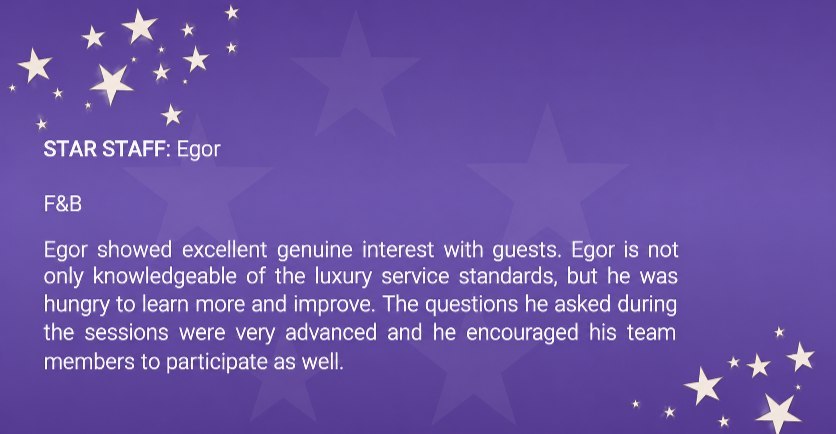 Translation: 'Egor showed great natural engagement with guests. Egor not only has the knowledge of luxury service standards but was hungry for new knowledge and progress. The questions he asked during the sessions were very advanced, and he also motivated team members to participate in activities.'
I won't pretend that I'm like: well yeah, just a typical Tuesday.
Of course, it feels good:)
But the story with stars doesn't end there. We actually have a Star Rewards system. You can get a star, for example, if a guest specifically praised you to a manager, if you did something extra for someone, or simply performed well in a certain situation. Sometimes the reasons are quite serious. And sometimes it's enough to... give HR a few more French fries. Yes, that is exactly how I also got one star. Another one was given to me specifically for becoming one of the "stars" of this training.
And these are not just stickers in the spirit of "well done, here's a high five." Later, these stars can be exchanged for various perks. For example, for a $25 gas station coupon. It's a small thing, but I like the mechanic itself. The company doesn't just tell employees: "let's provide good service," but gives a very clear incentive for specific actions. For praise from a guest, for initiative. And, judging by my experience, sometimes the path to luxury service really does lie through an extra portion of fries.
But the training itself still left me with a more interesting thought. We often perceive the ability to work well with people as some kind of innate thing. There is a person "for service," and there is a person who, apparently, was just unlucky.
In practice, everything is more complicated. Yes, character matters. But a huge part of good service consists of very specific skills: noticing, listening, remembering, formulating correctly, feeling the moment, and understanding the person in front of you. And all of this can be learned. That's why a smile and a routine "How are you today?" do not become five-star service by themselves.
But the ability to notice a small detail and do the right thing before you are asked for it - that is already much closer.